Scientists Create Giant Molecular Threads That Supercharge Brain Cells
A stunning breakthrough from Northwestern University offers new hope for regenerative medicine and neurological recovery
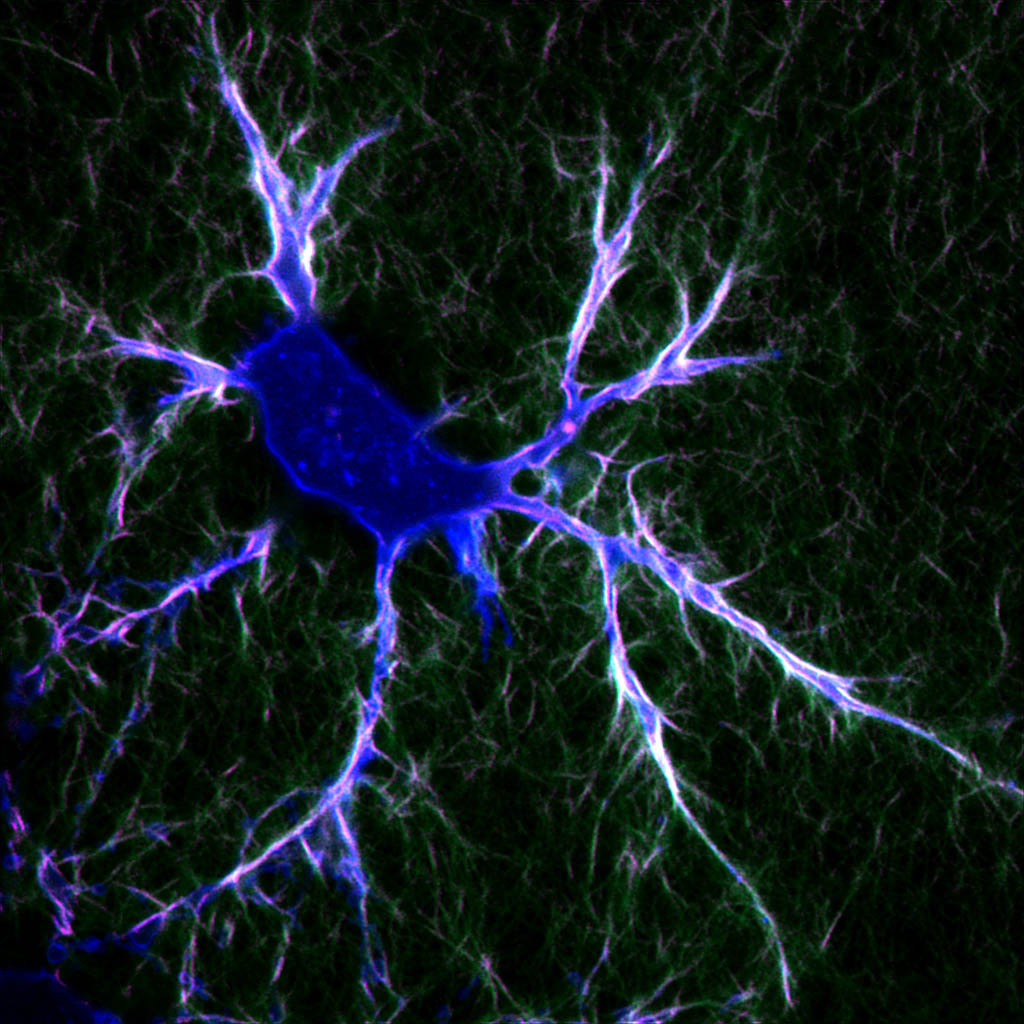
Charge-patterned molecular threads (magenta & green) interacting with a mouse cortical neuron (blue). Credit: Northwestern University
In a discovery that feels almost like science fiction becoming reality, researchers at Northwestern University have built the longest and most precisely controlled molecular threads ever created — structures so large they exceed the diameter of a human cell. These giant “supramolecular polymers” not only rewrite the rules of materials science, they also dramatically boost the growth and activity of brain cells.
The study, published in the prestigious journal Science in October 2026, was led by Professor Samuel I. Stupp and his team at the Center for Regenerative Nanomedicine. What makes the work especially exciting is that the molecular threads assemble themselves and can be patterned with extreme precision — something previously thought impossible at this scale.
How the Giant Threads Work
These structures are held together by weak, reversible bonds, making them soft and dynamic — perfect for interacting with living cells. The team developed a clever “self-capping” process that allows them to control both the length and the chemical sequence of the threads with remarkable accuracy.
When they designed threads with a small positively charged segment nestled between two negatively charged segments, something magical happened. The positive part gently anchors to the surface of neurons, while the negative parts remain mobile nearby. This gentle electrostatic “dance” appears to trigger powerful growth signals inside the cells.
Dramatic Effects on Brain Cells
In carefully controlled experiments, mouse cortical neurons exposed to the specially patterned threads behaved very differently from untreated cells:
- They grew much longer and more elaborate neurites (the branching arms neurons use to connect)
- After just seven days, their calcium activity — a key sign of neuronal firing — was four times higher
- After 14 days, they formed more synapses
- Human neural progenitor cells also formed beautiful three-dimensional clusters resembling early brain tissue
Importantly, other charge patterns either had no effect or were harmful. Only the precise “positive in the middle, negative on the sides” design produced this regenerative response.
Left: untreated neurons. Right: neurons treated with the charge-segmented molecular threads showing extensive growth. Credit: Northwestern University / EurekAlert
Why This Matters for America and Europe
Neurological conditions — from spinal cord injuries and stroke to neurodegenerative diseases — affect millions of people across the United States and Europe. Current treatments often focus on slowing damage rather than restoring lost connections. This new class of materials opens a completely new door: soft, biocompatible scaffolds that actively encourage neurons to grow, branch, and reconnect.
Because the materials are built from simple peptide-based molecules that self-assemble, they could eventually be produced at scale and delivered in injectable or implantable forms. Researchers are already exploring how similar designs might help repair spinal cord injuries and support recovery after brain trauma.
A Hopeful Glimpse of the Future
This is the kind of science that reminds us why curiosity-driven research matters. A team of chemists and materials scientists set out to control the structure of giant molecular assemblies — and in the process discovered a powerful new way to speak the language of living brain cells.
The road from the lab to the clinic is still long, but the early results are genuinely exciting. For patients and families waiting for better options, every new tool that encourages the brain to heal itself is a reason for hope.


Comments
Post a Comment